
An opinion piece in the Dutch newspaper Trouw further inflamed the discussion: we would literally be sleeping on a ticking chemical time bomb. As a sleep coach and product developer, I see unease rising among bed retailers and consumers at the appearance of reports with such glowing titles.
In this spirited opinion piece, Marjolein Vaders, CEO of Bedaffair, declares that we are sleeping en masse on toxic foam rubber. In doing so, she raises a legitimate concern, let’s be clear about that. But of course she is also concerned. Nothing wrong with that, because in fact I am too, but is what she is saying really that serious? Is it really that hard to find a toxin-free mattress? And does the mattress have to be made of natural materials?
In this article we take a closer look at mattress safety, with insights from Centexbel, Europur, TU Delft, UGent and others. Let us note that the soup is not as hot as it is served.
Harmful substances and chemicals in mattresses
The abbreviation VOC stands for Volatile Organic Compounds. These substances also provide, for example, the well-known “new smell” of a mattress. But are they dangerous? Centexbel (Belgian research center) recently invested in additional measuring devices to measure even highly volatile substances even better. And the standards of OEKO-TEX® and of Europur (CertiPUR) also recognize that certified foam mattresses do indeed emit volatile substances. At the same time, they all point out that these concentrations decrease, within 72 hours to almost zero, especially with proper ventilation.
For 95% of the population, “near zero” is fine, because for them the impact is negligible. In contrast, for the remaining “highly sensitive 5%” (people with allergies or chemical hypersensitivity), even this minimal emission can be irritating.
Foams are created after chemical building blocks, often from petrochemicals (natural gas, naphtha) or biobased (soy, rapeseed …), initiate a foaming process. The result is extensively washed, tested and controlled before the product is processed in the mattress industry.
The claim that foam mattresses are by definition “toxic” ignores strict EU standards and also calls into question the research results of certificates. It is not the presence of chemistry that matters, but its emission, or in other words, what is actually released?
For enthusiasts, EU standards can be found in REACH and are followed up by ECHA.
The yardstick for a truly toxic-free mattress
Product designers use the R ladder to rule out, from the product idea, problems higher up the ladder. So for them, the first two steps are crucial. The entire R-ladder (Lansink) consists of the following steps: Refuse, Rethink, Reduce, Reuse, Repair, Refurbish, Remanufacture, Repurpose, Recycle and Recover.
Currently, there are already many materials for mattress production that can be used circularly. For example, there is LDPE, a polymer that is used as a mattress filling or cover and can be reprocessed into the original product after use. Natural materials are also suitable as circular materials. Certain mattress manufacturers use hemp, horsehair, silk and various types of wool as covers for mattresses. These mattress components are also, in most cases, biodegradable after use.
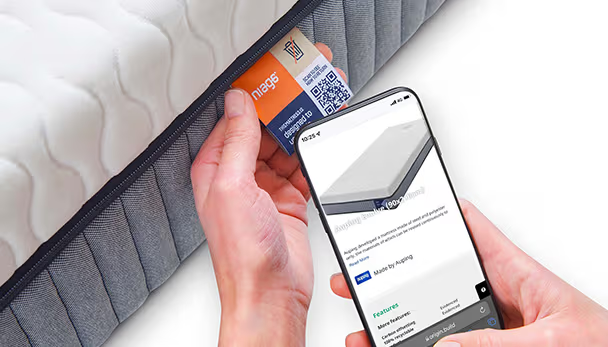
Mattresses themselves, given the right design, could also be repaired (Repair) or restored to their original condition (Refurbish). The current economic reality is that retail is not focused on this. The focus is mostly on selling new mattresses. But there are certainly opportunities here, as Marjolein Vaders’ company itself demonstrates. Especially if the parts are known, repair becomes easier. A digital product passport (DPP) can play an important role here.
A major obstacle to a clean mattress is glue. Traditional mattresses are “glued sandwiches” of different materials. This makes high-quality recycling either impossible or very difficult.
The future is likely to be modular. Mattresses where layers are knotted (tufted), fastened or connected with innovative techniques such as Niaga® adhesives can be completely disassembled at the end of their life. This leaves a pure fraction. Belgian manufacturer Revor and Dutch company Auping are already applying this gluing technology.
Traceability is very important , and here too the importance of a digital product passport comes to the fore. Only when the individual product can be processed into clean parts and when proper instructions for dismantling are available is it possible to have fewer or no residual fractions.
There, in the current setting of the market, the opinion maker in the Trouw article certainly has a point. But overcoming this hurdle is not so easy. The strong belief that the problem will be solved if we select materials that come from the organic cycle perhaps puts things just a little too rosy. But that something has to change thoroughly is absolutely true.
Are natural materials always safe?
Brands that bet on hemp, silk, wool and horsehair have a strong story. These materials ventilate and insulate much better and have powerful moisture-regulating properties.
But be aware that every story also has drawbacks. Animal materials (wool, hair) require intensive cleaning to prevent bacteria and mold or processing to complete a finished product:
- Wool is often carbonized (a process involving sulfuric acid) to remove stubborn plant debris.
- Horsehair is often still“bonded” with latex. If this is synthetic latex, petrochemicals are still added to a natural product.
- Natural silk is often obtained by boiling off live caterpillars, mulberry leaves are treated with pesticides, and synthetic fertilizers pollute the soil. A fascinating explanation can be found here.
In short, the environmental impact of natural materials can be quite large. Again, chemicals or processes are used that can end up in mattresses. So to simply consider “natural” as safe is too short of the mark.
Checklist: How to choose a safe and toxin-free mattress?
In the meantime, do not be guided by fear, but rather by certificates, solid information and trusted partners. If a vendor makes a claim, ask for the certificate with the claim or scan the Digital Product Passport (DPP) through the mattress label.
Be sure to check out the different labels attached to a mattress. They have meaning and protect your health. Certificates test for a wide variety of things, including animal welfare, the use of carcinogens, toxic chemicals, soil contamination, sustainability and so much more. These are some well-known labels you may find on mattresses:
| Label | What does it guarantee? |
| OEKO-TEX® (Standard 100). | Free of harmful residues in the textile or foam |
| CertiPUR (Europur) | Safety and low emissions in the foam used |
| GOLS / GOTS | Biological origin of latex and textiles |
| FSC | Sustainable sourcing including wood and natural rubber |

Know who you are buying a mattress from!
Is sleeping on a mattress made of foam or foam rubber dangerous? No certainly not, provided the product is manufactured correctly, according to strict European rules, and certified by recognized research institutes or labels.
As a consumer, you need not be afraid when you buy a new mattress. However, you may be critical of the manufacturer’s transparency and know from whom you are buying. Soon, a widely implemented digital product passport will provide more transparency.
A good mattress is an investment in your health and the future when you know what you are buying.


